Tuesday, August 21, 2018

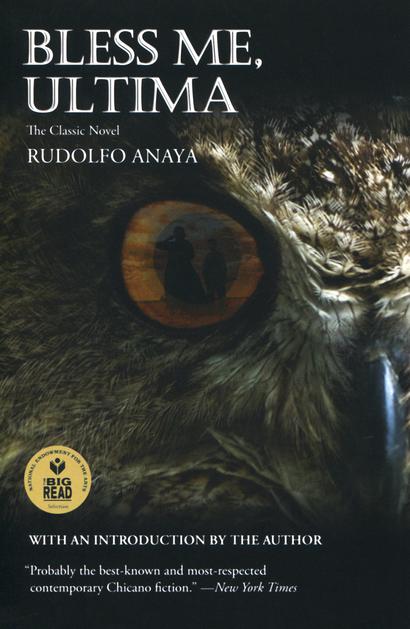
Bless Me, Ultima by Rudolfo Anaya


Book 10 of 100 in the Great American Read list.

Bless Me, Ultima is Magical Realism in its purest sense. Magic, animal spirits, dreams, folk legends, gritty circumstances and wonder. But Magical Realism is a distinctly Native American and Latin American genre, I was nervous about reading this book, I thought it would be alien to me, so far outside of my own experience that I wouldn't understand it.

So, I worked hard to understand context and imagery, and it was worth it. Stopping to look up translations of phrases in Spanish was an education in itself. I also read a children's book of folk tales from New Mexico, which helped me learn more about the imagery, but also about the route of Fairy Tales from the old world witches to the new world brujas.

I was talking to a colleague about Bless Me, Ultima and had cause to say the word Chicano out loud for the first time. Before I read this book, I didn't realize that Chicano was any more than a racial slur. Because that's the only way I'd heard it used. My colleague (who considered herself Chicana when she was growing up on a farm outside Sacramento) explained to me about how that identity became synonymous with the Chavez labor movement. All this was American history I didn't know before. But I do now.

Antonio is the young son of a poor Chicano family in New Mexico during the second World War. His mother brings a local wise woman and healer (or curandera) into their household and trouble follows her. That trouble is particularly hard on Antonio who forms a strong, but wary connection with Ultima because his intelligence and empathy leave him open to her magic. The book shows us Antonio's coming of age as a part of the constant struggle between ancient and modern religions as well as the struggle between the two parts of his personality, the wild and free vaqueros like his father and the gentle domesticated Lunas like his mother.

There are some surprising parallels between The Adventures of Tom Sawyer and Bless Me, Ultima.
Superstition and tales of ghosts and witches are key elements in both stories. There's a real sense of physicality of children, as both Antonio and Tom experience things by doing them. Both Injun Joe and Jason's Injun are ominous portents. Both the protagonists witness a murder while they are young.
And the presence of the river is an important backdrop, in some instances, even a character.

But the differences between these two books are massive and perhaps more telling. For Antonio, the superstitions are true. Ultima really is pulling a curse out of his uncle Luca, the owl really is her familiar. The murder affects Antonio enormously and he's much more empathetic than Tom.

Why is it on the list? Most likely because it's the earliest example of a successful novel about the Chicano experience. This makes Bless Me, Ultima much in demand for multicultural studies and world literature classes. But it's important to remember that the book originally sold by word of mouth within Chicano communities.

Ishmael Reed wrote in his preface to Conversations with Rudolfo Anaya that:

"It was published by Tonatiuh International Inc., in Berkeley, California. It has sold 80,000 copies without a review in the major media."

If ever there was an argument for "own voices" publishing. Bless Me, Ultima is it.

There's a section in the middle of the book where Antonio and a few other boys are snowed into the school and with the help of a sympathetic teacher create a chaotic nativity play. It's a strangely comic interlude, which most likely serves to remind the reader that Antonio is still a child. The "chaotic nativity play" could well be described as a genre of English comedy. From Joyce Grenfell to Nativity! there's plenty of comic mileage in the English tradition of every public elementary school's annual production of the story of the birth of Jesus.

Bless Me, Ultima could easily have been too alien for me to comprehend, instead it both taught me something new about America and reminded me that within the vast experience of America there is some commonality with my own experiences. And that makes it a very good book indeed.

Wednesday, August 8, 2018

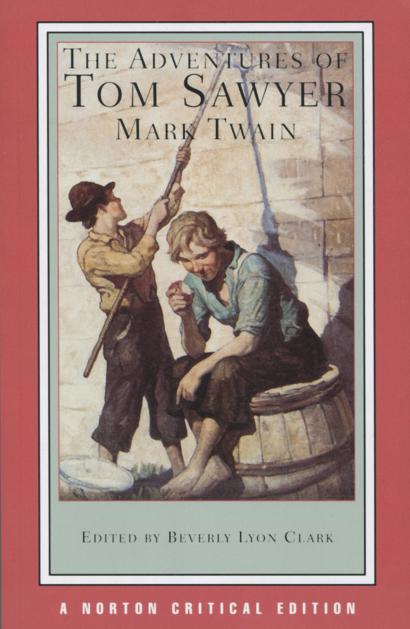
The Adventures of Tom Sawyer by Mark Twain


Book 9 of 100 in the Great American Read list

When I first came to America I thought there were probably a few books I could read that would catch me up on American Culture 101. I started with Leaves of Grass but found it pompous and self-important. Then I wandered around novels set in Five Points in the late 1800s, because sooner or later PT Barnum made an appearance and he seemed more American than Walt Whitman. Then I discovered Tall Tales, the folklore of America and I was deeply satisfied. Here was a whole genre of simple stories that proved my theory that all Americans are con-artists and tricksters who want to steal your time and take your money.

Needless to say, ten years later I've tempered that opinion somewhat. The more Americans I meet and the more states I visit I get a wider understanding of the American character and the diverse nature of the population. Now I would say that only most Americans are con-artists and tricksters who want to steal your time and take your money.

Which brings me (eventually) to The Adventures of Tom Sawyer a book about an idealized childhood that feels more like a series of Tall Tales plucked from the clean Missouri air. When Tom sells his classmates the privilege of whitewashing Aunt Polly’s fence, it reads like a morality tale, a fable or at least a story you’ve heard before.

The Adventures of Tom Sawyer is the story of a boy and his friends spending the summer getting into trouble and tricking the unwary. But there's also a darker story here. Tom witnesses a brutal murder, fears for his life, identifies a murderer at a trial, gets lost in a natural cave system with the killer for three days and finally sees him brought to natural justice by being sealed into the cave to starve to death. I read this book as a child and I didn't remember that it was a psychological thriller. I just remembered the funny bits.

And yes, it is funny. There were countless times I smiled while reading and when Twain breaks the fourth wall in order to draw a curtain over the consequences of Tom's failure to know any scripture I actually laughed out loud. Twain builds up the tension and then pops that balloon with a careless style. It's also a dashing adventure story, a sappy romance and a morality tale. Only in a Mark Twain book would a vagrant child turn down a fortune in gold because he doesn't want to wear shoes.

Why is it on the list? Other than the moral of the tale being that the wily and immoral will always prosper. There's also plenty here that venerates childhood and idealizes nature. Tom Sawyer is a soft focus version of the pick-pocket urchins of Charles Dickens. More beautifully atmospheric and less premeditated.

Another thing that stood out for me is the theme of superstition, some which Tom invents and some which he actually believes. He or his friends are scared of ghosts, witches, ha'nted houses, howling stray dogs and starting an enterprise on a Friday. There's a whole chapter about how a dead cat can cure warts if you say the right words over it. Of course, Twain's point here is not to venerate superstition, but to hold it up to ridicule, but he certainly has plenty of material to work with. I was reminded of the difference between Halloween in America, where it is a huge and excitable candy sprinkled festival of fear and Britain, where it is a gloomy night.

Mark Twain is a legend himself. A giant mustachioed epigram generator. A satirist for all time. A true American iconoclast. It's a wonder to me that this pillar of satire hasn't crumbled. After all, the book continues to be banned or challenged for it's racist language. And the presentation of Native Americans as desperate barbaric murderers is pretty uncomfortable reading. Perhaps there really is an American tendency to venerate the confidence trick. After all, there's a con-artist in the White House right now and he isn't the first.

Tuesday, July 31, 2018

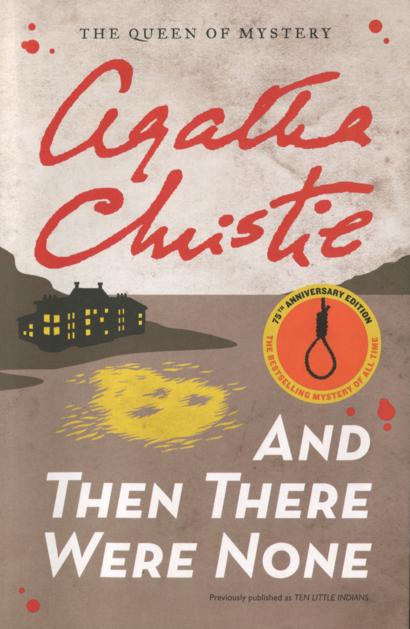
And Then There Were None by Agatha Christie


Book 8 of 100 from the Great American Read list.

In my early teens I read as many novels by Agatha Christie as I could get my hands on. I had spent my childhood reading Enid Blyton books from the 1930s and 40s, so the old fashioned language and archaic social attitudes were comfortably familiar to me. The public library had a seemingly endless supply of Agatha Christie books and although I never managed to read all of them, I think I’ve certainly read more than 20. Every one of these polite murder mysteries surprised me with the big reveal. Each time I thought I knew whodunnit, but then my choice of villain would end up as the third corpse. Over the years I’ve always believed that thirteen-year-old me must have been the perfect Agatha Christie reader.

Fast forward to today and I just reread And Then There Were None. Once again I happily devoured the book and once again my best guess at the murderer was still the third victim. Yes, even though I'd read it before.

In the interest of not spoiling an exceptional story, I will tell you only this. Ten strangers arrive on a remote island and are picked off one by one in the manner described by a morbid nursery rhyme. There’s a Colonel, a governess, an undercover cop, a few servants, a retired judge, a surgeon, a colonial sort, a religiously fanatical older woman and a playboy. The murderer could be any one of them.

And Then There Were None is widely believed to be Agatha Christie’s best book and she was justifiably proud of it. This is from her autobiography which was reprinted in the edition I read:

“It was well received and reviewed, but the person who was really pleased with it was myself, for I knew better than any critic how difficult it had been.”

I think it’s a wonderful book, maybe not a work of genius, but certainly a pleasure to read. The plotting is done on a knife edge where every second counts and every flourish of the murderer is exactly meaningful. The language is straightforward, which adds to the readability but underneath that simplicity are characters who are much more complex than the cliches they first appear to be. Meanwhile, the structure makes my head spin. Ten characters, each under equal suspicion must be satisfactorily introduced, suspected and killed. It’s quite an achievement.

Why is it on the list? Well it turns up on lots of lists of the best mystery books of all time and it usually ranks quite high. There’s this NPR poll from 2010, or you could trust the Mystery Writers of America. But the popularity of And Then There Were None is far from just an American phenomenon, the UK Crime Writers Association also rate it highly. According to Wikipedia it has sold over 100 million copies worldwide. And it’s been made into countless tv shows, movies and plays. This is a very popular book all over the world.

Have we found the perfect book to bridge the Atlantic? Well, there is a notable difference between the early UK and US editions, which bears some examination. When I first read this book as a teenager, it was called Ten Little Indians, the island was called Indian Island and the nursery rhyme was Ten Little Indians. But the earliest edition was even worse, in 1939 in the UK, the book was called Ten Little Niggers and the name of the island and the rhyme matched the title. The following comes from Wikipedia.

“Both of the original US publications changed the title from that originally used in the UK, due to the offensiveness of the word in American culture, where it was more widely perceived as a racially loaded ethnic slur or insult compared to contemporary UK culture, and because of the pejorative connotations of the original blackface rhyme.”

I often say that American racism is different to British racism and this is a perfect example. The term is simply more pejorative in America where it was widely used as an aggressive slur for so long that it's now a forbidden word. In the UK, it wasn't widely used that way until we learned about the usage from Americans. I'm not saying there isn't racism in the UK. For example blackface performances were popular on television until 1978.

And one last thing. Christie uses Americans as a shorthand for eccentric decadence. The previous owner of Soldier Island is an American millionaire whose parties are so extraordinary that the locals think nothing of cutting off shipments to the island as “an experiment in survival”. Americans are apparently wealthy, carefree and unpredictable. A national characterization which is still easily found in British literature to this day, even though it’s decades out of date and was never entirely true to begin with.


Sunday, July 29, 2018

A Confederacy of Dunces by John Kennedy Toole


Book 7 of 100 from the Great American Read list.

"Oh, my God!"

This is the first of the books on the Great American Read list that I couldn't wait to get through. It was such a slog. Normally, when I read a book that I dislike this much, I stop reading and I don't review it. So this might get controversial.

A Confederacy of Dunces does not have a plot. Instead it meanders around New Orleans gathering descriptions of insanity, frustration and general uncomfortableness. Every sentence is as monstrous as the protagonist's stomach. The style is a deliberate choice, of course. If a sane reader is to have any empathy for Ignatius J Reilly we need to suffer through his torturous language and "world view" so that we can feel his impotence. But it’s hard going for me.

The awkward humor of watching a character go through a mental breakdown always makes me cringe. Unfortunately, the Brits are brilliant at this kind of humor. Alan Partridge, The Office and (worst of all) The Royle Family make me look away while everyone else is laughing. When Ignatius is attempting to get support for his "Campaign for Moorish Dignity" on the factory floor, he gets embarrassed and starts dancing. At least I know where David Brent came from now.

And yet, people apparently love this book. One of my colleagues told me that her boyfriend always has a copy of A Confederacy of Dunces with him. His copy is so well read that it's fallen in two halves. My American roommate from London who introduced me to my husband gave me her copy of this book when she left the UK. Thank god she has better taste in men than in books.

So why is it on the list? Well, rants are fun to read and even though I don’t think it’s funny, I know other people who would find it hilarious. But there are other more complex factors at play.

Ignatius has many ideas and most of them seem insane. His political ideologies are all over the road. I think if I had to pin down his “world view” I’d liken it to Kanye West in “Free Thinker” mode or Steve Bannon's "burn it down" philosophy. The fact that I can find parallels with Ignatius J Reilly in America today may seem remarkable, but I think it’s part of the appeal of the book. We all know an Ignatius J Reilly, I think one might currently be president.

Having said that, I don’t think any of us is totally free of extreme ideas. I think we can all find something in Ignatius’ ramblings, which we might be persuaded to believe, given the right encouragement.

I have noticed that belief is often confused with truth, as I saw in a Facebook comment a few weeks ago “don’t argue with a liberal, they just ask you to prove it”. And Americans love to believe, especially in themselves. But not everyone’s beliefs can be true. Just as not all of Ignatius’ legion of beliefs can be true. So like any good satirist the author turns up the volume on our ideas and shows us how absurd they are.

I’d like to finish up with a few thoughts about the women in this book. There are no sympathetic female character here. There are some male characters that we warm to, Burma Jones was a favorite of mine and the long-suffering but fair-minded Gus Levy seemed to be the most sensible character in the book. But the women are just charicatures.

Almost all the disasters that befall Ignatius in A Confederacy of Dunces could easily be attributed to the women in his life. His mother spoils him, his girlfriend provokes him, the woman he believes will be the love of his life is not what he expects and even the women of the choir at the factory undermine his authority. Ignatius believes that he has no agency, he is tossed from one misadventure to another by the capricious turns of Fortuna’s wheel. But all these women, including Fortuna, are not responsible for Ignatius’ mistakes. He is. I walked away with the uncomfortable feeling that Ignatius might now be described as an incel.

But uncomfortableness is the point of satire and it’s definitely the point of A Confederacy of Dunces. Maybe I should have written a one word review.

Awkward.


Tuesday, July 3, 2018

The Color Purple by Alice Walker


Book 6 of 100 on the Great American Read list.

I read The Color Purple at University in the UK for a feminist literature class. And I am ashamed to report that I didn’t remember much about it. Rather like Squeak I did smoke a lot of reefer at the time, so maybe that’s why. It’s more likely that I just lacked the context to be able to read it deeply.

After ten years in America, I have a slightly better idea of the context for The Color Purple. I've read more black authors, learned more black history, listened to black activists and I’m trying to see a big picture. The picture is huge. As big as the world. I doubt I’ll ever see all of it because I'm not black and I’m not American. So bearing in mind that my understanding of the context is still imperfect, here’s what I thought this time I read The Color Purple.

Never in the history of anything has a book that begins with the sexual abuse of a child contained so much joy and life.

The Color Purple is told through the prayers and letters of Celie and her sister Nettie. The two girls grow up together in the South in the 1930s, Celie stays in Georgia, while Nettie becomes a missionary in Africa. Mostly, the plot rests with Celie, we only hear from Nettie when Celie gets access to her letters. And Celie's life is hard. Raped by her supposed father, her children are taken from her and then she's worked relentlessly by an abusive husband who's name she doesn't even know. It's a disturbing story. But then her husband brings home an old flame, the jazz singer Shug Avery and Celie's relationship with this dazzling woman restores her humanity and her faith in god. Eventually, Celie turns on the abusive husband, becomes a successful business woman and is reunited with her sister and children. And when she does, it is incredibly cathartic.

Why is it on the list? Because reading it is an affirmation of being alive. Because there should always be stories about black lesbian feminists on school reading lists. And because it’s an incredible work of historical fiction.

Alice Walker crams a lot of African American history into The Color Purple. It's sometimes hard to remember that it was written as late as the 1980s. In the West African letters Nettie is amazed to discover the history of the African Kingdoms. She also sees white colonization with her own eyes when the rubber road arrives to destroy the Olinka village. Meanwhile in Celie's letters, her friend Sofia experiences something similar to being a house slave, even though the book is set post-slavery. There’s also the history of the influence of black culture on America in the juke joint, Shug Avery’s rise to fame and fortune and black female entrepreneurship. Religion, hair, sexuality, lynching, language, toxic masculinity, colorism, incarceration, mental health and communal child rearing are also here, along with probably much more that I’m missing because I’m still learning.

The Color Purple feeds and enriches American culture. The book won the Pulitzer Prize for Fiction in 1983 and was made into a movie in 1985. The movie was nominated for 11 Oscars (although it didn't win any of them). The film launched the career of Whoopi Goldberg and truly established Oprah Winfrey as a force to be reckoned with. I see references to The Color Purple in Beyonce's Lemonade. On the flip side The Color Purple ranks high on the ALA list of 100 most banned or challenged books.

I can’t think of a better book to help me understand America.

(A small note, I thought long and hard about capitalizing Black here, but after some research I landed on the side of those who wish to acknowledge the diversity of blackness and not reduce it to a monolithic culture. Although, the arguments here also make sense to me.)

Tuesday, June 5, 2018

The Book Thief by Marcus Zusak


Book 5 of 100 on the Great American Read list

My boss loves The Book Thief it's her favorite YA book of the last 20 years. I asked her why she loves it and she gave me many reasons including the clever narrative structure and the memorable graphic novel elements. Mostly though, she likes the narrator, because she likes Death’s sense of humor.

I started out listening to The Book Thief as an audio book, so it took me a while to figure out that the structure was like a shelf of stolen books, each with a contents page of chapter headings. Then my boss told me about the graphic elements and I realized I was definitely missing something. I ran out to the library and borrowed a copy. Having a real copy of The Book Thief in your hand is essential to reading and understanding it.

What’s it about? The Book Thief is a young girl named Liesel Meminger, she is nine years old when we first meet her and 17 years old at the end of the story.  She’s growing up in a small town in Nazi Germany with her foster parents and a childhood trauma that gives her nightmares every night. As the Nazi Party grows in power so does her desire to read, which leads her to steal books from a graveyard, a bonfire and a library. The family shelter a Jewish man named Max who writes books for Liesel on pages torn from Mein Kampf and painted over with white house paint. When the Allied bombs start to fall, Max must escape, Papa must go to war and Death, who narrates this book, must be busy.

Is it any good? Yes. Definitely. It’s one of those books with haunting images that you carry around with you for a long time after you finish reading. The “parades” of “Jews and other miscreants” shuffling tiredly down the road toward Dachau. Rudy Steiner standing waist deep in freezing water to retrieve a book and standing there longer to ask Liesel for a kiss. The Standover Man, the book written by Max while he hides in the basement, with the text of Hitler’s book showing through in places beneath the paint.

And my boss is right, Death is an excellent narrator with a dark, ironic and fatalistic sense of humor. After a day of small victories for Liesel, Death tells us:

“The day had been a great one and Nazi Germany was a wondrous place.”

And he never lets his readers hope for a happy ending to this story.

“I know what happens and so do you”.

Despite his best intentions Death ends up paying considerable attention to the stories of the humans whose souls he will inevitably gather. He’s an empathetic character, although he’s tortured by that empathy.

“I am haunted by humans.” Is his final sentence in the book. And honestly, I am haunted by them too.

Why is it on the list? I recently talked to a colleague of mine who is a Senior in High School, she told me that in Junior year her whole class have a reading list the students call “Death and Destruction” and The Book Thief is on that list. It’s high on the list of popular books for Book Clubs on Goodreads and to date has sold 16 million copies worldwide. It’s a crossover book, read by adults and teens alike. The Book Thief is big news everywhere.

What interests me is the The Book Thief’s window into reasons for emigration to the US from war torn Europe. I expected there to be an influx of  Jewish refugees to America, although I was surprised to learn that the American government initially turned away boatloads of people until the Displaced People’s Act of 1948. The Book Thief introduces us to a German population, starved, terrified and oppressed. No wonder they left Germany.

From 1941 to 1950, 1,035,000 people immigrated to the U.S., including 226,000 from Germany, 139,000 from the UK, 171,000 from Canada, 60,000 from Mexico and 57,000 from Italy.[50]

Perhaps this is one of the reasons for the continued worldwide popularity of this book. Many families left the old world after World War II, so to read about their ancestors reasons for leaving must be powerful indeed.

The Book Thief inspires empathy and compassion in its readers, so the popularity of the book is heartening. After all, if Death can manage all the feels, then so can American readers.

Friday, June 1, 2018

The Great Gatsby by F Scott Fitzgerald


Book 4 of 100 on the Great American Read list

I have started reading The Great Gatsby on three previous occasions and each time I’ve stopped before the end of the first chapter. The characters in that first chapter are white supremacist rich people, who lie around in a mansion and whine. They drink disinterestedly while our narrator impassively reports on them as though they were perfectly normal. It’s kind of nauseating.

So this time, I downloaded an audio book version and went for a walk. I am happy to say that I made it past the first chapter and into the second. Here it becomes clearer that the author also feels sickened by his characters. When Tom Buchanan breaks Mrs Wilson’s nose with the flat of his hand at the end of chapter two, there is no longer any doubt; these people are awful.

What’s it about? The Great Gatsby is the story of a summer spent among the super rich of the 1920s. One man Jay Gatsby gives extravagant parties at his Long Island mansion every weekend, but has a mysterious past. Another power couple struggle with infidelity. There are at least three murders, an underground crime syndicate and a deeply disturbing obsession.

Is it any good? As a work of satire against the unfeeling upper classes, The Great Gatsby hits its mark hard, The book is full of excellent one-liners, including a dismissal of the white supremacy from chapter one as “impassioned gibberish” and the nasty complement “her voice is full of money”. But it’s not just the rich who feel the sharp edge of Fitzgerald’s wit. Mrs Wilson is firmly middle class despite her aspirations and everything about her character from her speech pattern to her violent death is grotesque. Gatsby himself doesn’t escape criticism and is also the victim of a violent death.

Which brings me to the wider theme of the book. Yes, the indolent rich are awful, but they will get away with it. The only people who suffer and die in The Great Gatsby are those born without money, born outside the elite society and whether they shun riches or desire them, the money will kill them in the end.

Why is it on the list? The answer is probably High School reading lists. The book is short, the themes are simple and numerous, the language is rich, the parties are exciting, the deaths are gruesome and there are a number of movie versions of the book to help out students who are hard-of-reading. It’s a very teachable book. I can imagine numerous lesson plans and I’m only a bookseller.

I also think The Great Gatsby is on the list because of America’s complex relationship with money. American society requires money for everything. Healthcare, retirement and other social safety-nets found in first world countries are just not available in America. But if you have enough money to escape the metaphorical wasteland, the continued pursuit of greater and greater wealth often looks less gorgeous than the things you can buy with it.

That’s a pretty depressing take-away for a book with some funny drunks and exquisitely detailed parties.